
When evaluating a butterfly valve manufacturer, beyond essential factors such as body and seat materials, pressure ratings, and certifications, there is another often-overlooked factor: machining precision.
A butterfly valve may begin as a high-quality casting, but the casting alone does not determine the valve’s final performance. Prior to assembly, critical surfaces, bore locations, functional dimensions, and sealing diameters—which require exceptional geometric precision and surface finish—must undergo precise machining.
CNC machining is the key factor determining the precision and performance of butterfly valve components. It influences component positioning and alignment, seat placement, sealing performance, operating torque, and overall service life.
1. From Casting to Finished Butterfly Valve: Where Does CNC Machining Fit In?
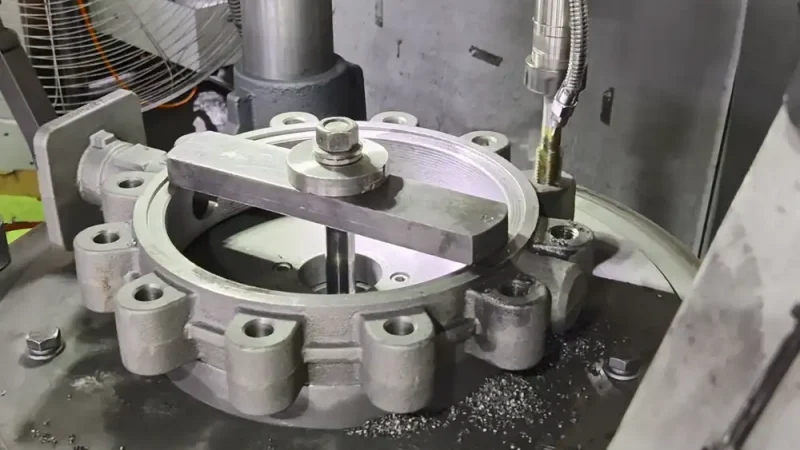
A typical butterfly valve manufacturing process can be summarized as follows:
Casting of raw parts → Casting inspection → CNC machining → Precision inspection → Assembly → Pressure testing → Final inspection
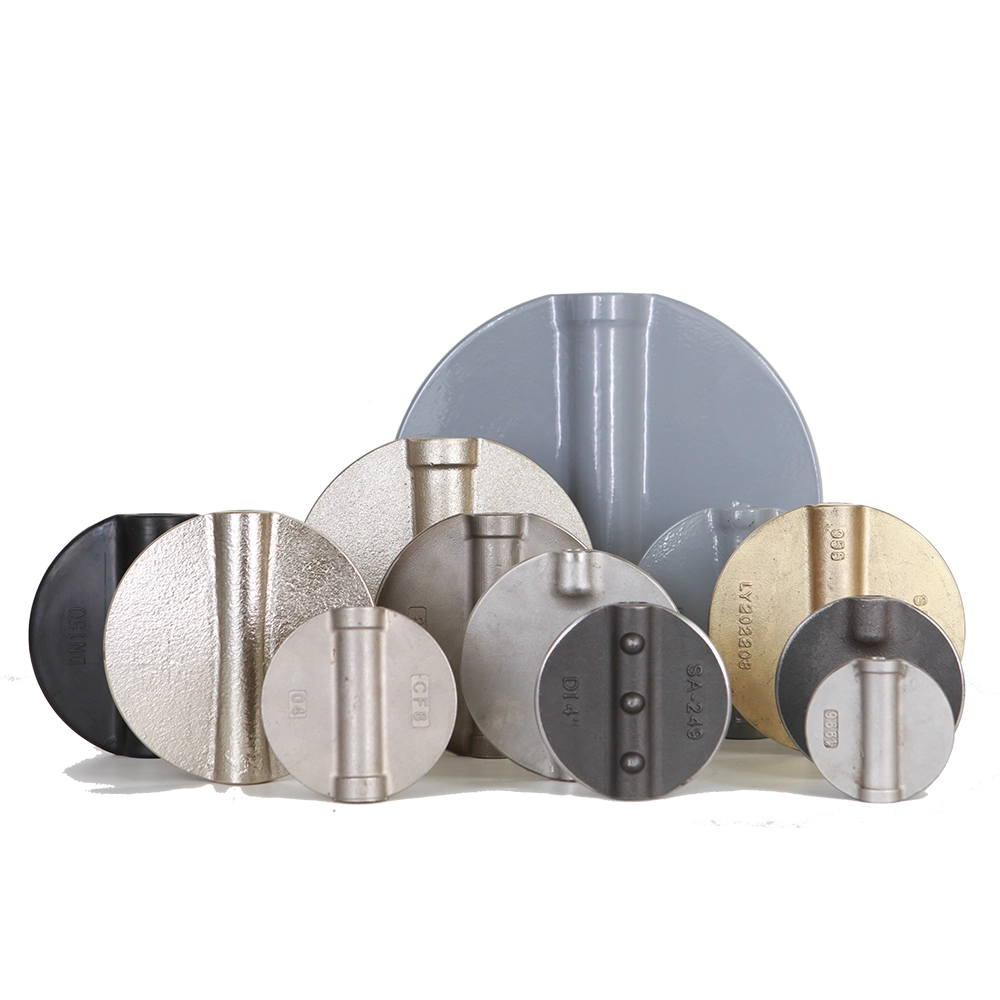
Casting establishes the basic shapes of the valve body, disc, and other components, while CNC machining handles the critical dimensions and functional surfaces specified in the valve design.
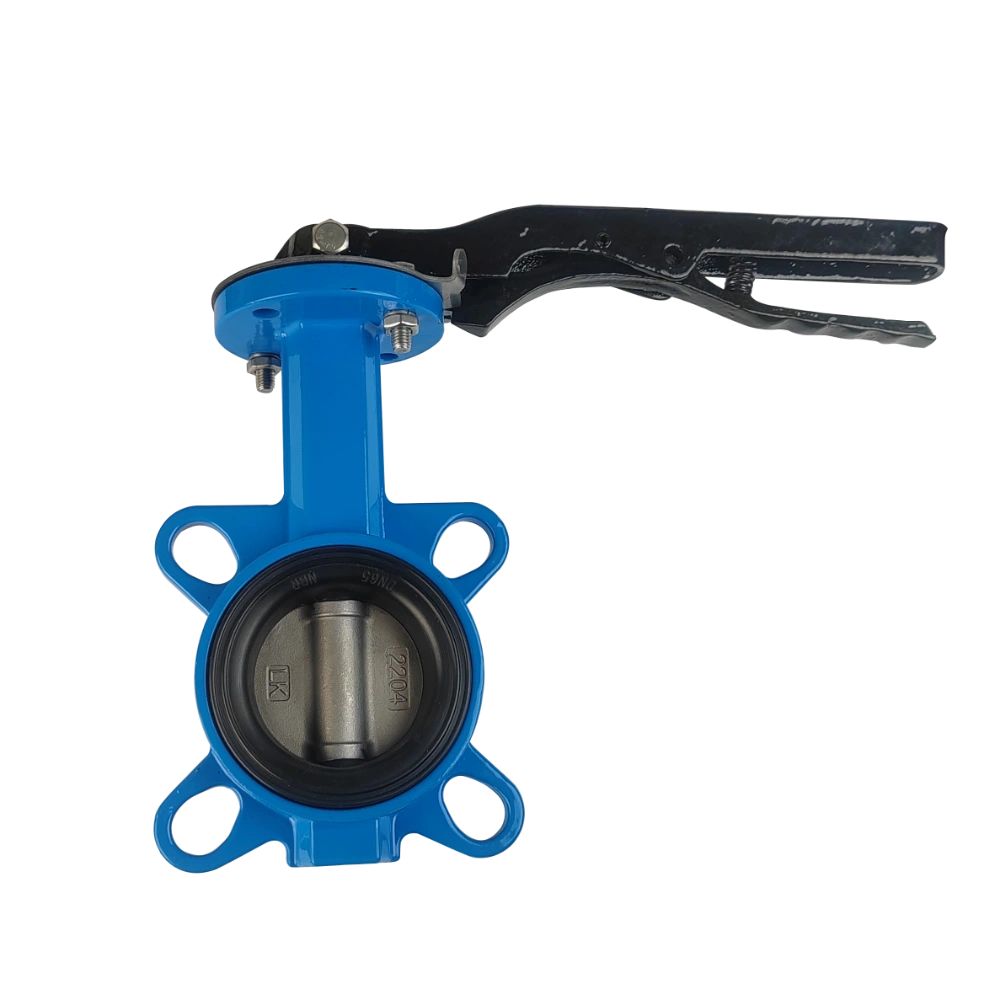
The following are areas of the butterfly valve that require high machining precision. Controlling these critical dimensions is paramount, as they directly impact valve performance:
Flange mating surfaces
Valve body bore
Seat groove (for replaceable soft-seated valves)
Stem bore
Threaded holes (for lug-style valves)
Disc-to-stem connection area
Top mounting flange
The quality of these machined areas directly affects the performance of the finished butterfly valve.
2. Which Parts of the Butterfly Valve Require CNC Machining?
2.1. Flange Mating Surfaces
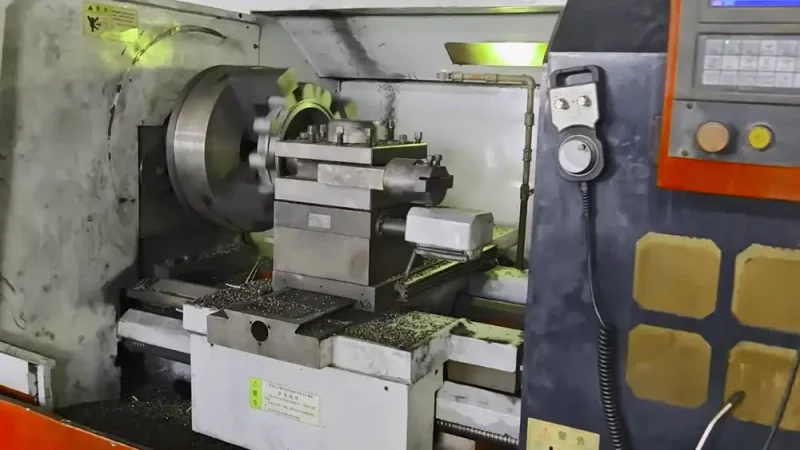
The flange mating surface refers to the interface where the butterfly valve connects to the pipeline; the importance of this area is self-evident.
If the machined surface is uneven or lacks dimensional consistency, it can not only complicate on-site installation but also increase the risk of leakage at the pipeline connection.
Therefore, machining the flange surface is about more than just making it “look smooth.” Even more critical is the control of:
Surface condition
Flatness
Dimensional accuracy
2.2. Valve seat groove
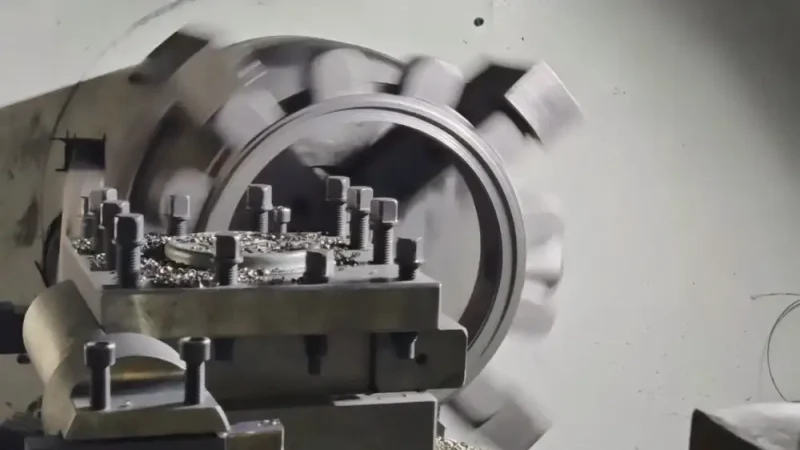
The valve seat groove is particularly important for butterfly valves that utilize replaceable seats.
The groove determines where the seat is installed within the valve body. Its dimensions must match the seat design to ensure proper installation and maintain a stable sealing position during valve operation.
If the groove is too wide, too narrow, of incorrect depth, or misaligned, it can affect:
Seat installation
Contact between the disc and the seat
Sealing performance
Operating torque
Seat wear
This is one of the reasons why CNC machining directly impacts the sealing performance of butterfly valves.
2.3. Stem bore
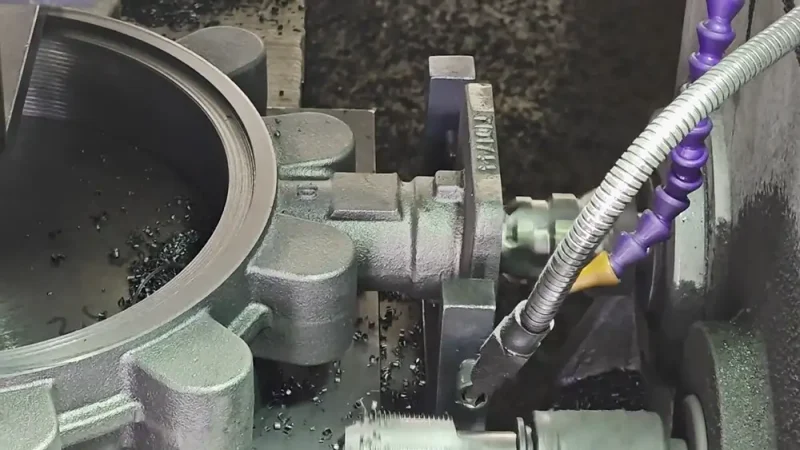
The stem transmits power from the actuator or operating mechanism to the disc.
Consequently, the position and dimensions of the stem bore influence the interrelationship between the stem, disc, body, and seat.
Poor precision can lead to:
Uneven localized contact
Increased friction
Higher operating torque
Premature seat wear
2.4. Top mounting flange
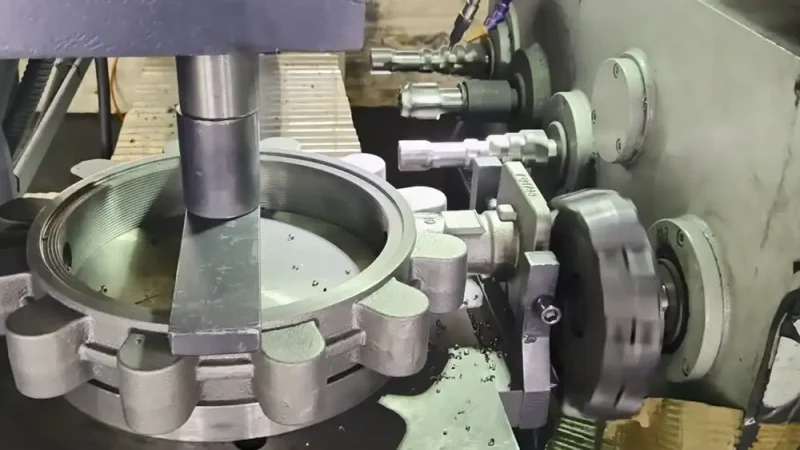
Precision machining of the top mounting flange ensures correct alignment between the actuator and the stem, guaranteeing efficient torque transmission.
This is especially critical for automated butterfly valves using pneumatic or electric actuators.
In such cases, the valve and actuator cannot be viewed as two separate products.
The valve body, stem, and actuator actually constitute a single, integrated operating system.
3. How does CNC machining precision affect butterfly valve sealing?
This involves a crucial logical chain in butterfly valve manufacturing:
Machining precision → Component alignment → Seat contact → Sealing performance
The disc must move along a designed path within the valve body; therefore, the stem, disc, seat, and body are not merely independent parts but components that must work in unison.
For instance, significant deviations in the position of the stem bore or the seat groove can result in uneven contact between the disc and the seat.
This may lead to:
Excessive contact pressure in some areas and insufficient contact in others. Prolonged operation may lead to:
Increased operating torque
Localized seat wear
Difficulty in closing the valve
Premature seat failure
Leakage after a period of use
Therefore, high-quality CNC machining does not mean that every dimension must achieve “extreme precision.”
What truly matters is:
Applying stricter, reasonable, stable, and consistent machining controls to the critical dimensions that affect the butterfly valve’s performance.
4. How does CNC machining affect the butterfly valve’s operating torque?
Operating torque is another aspect that is easily overlooked.
It can be understood as follows:
Machining precision → Disc-to-stem alignment → Seat contact condition → Friction → Operating torque
If there is excessive or uneven contact between the butterfly valve disc and the seat, the torque required to operate the valve may increase.
If the actual operating torque exceeds expectations, a larger actuator specification may be required.
In more severe cases, the issue goes beyond increased actuator costs; excessive friction can also accelerate seat wear.
Therefore, when evaluating a butterfly valve actuation system, one cannot consider the actuator in isolation; the valve’s own machining precision and actual operating torque must also be taken into account.
5. What is the relationship between CNC machining and butterfly valve seat life?
As mentioned earlier, imprecise machining of any component can affect seat life; however, the relationship between machining precision and seat life is sometimes overlooked.
In concentric butterfly valves, the disc passes through the soft seat during opening and closing, making friction between the disc and the seat inevitable.
If the disc is not properly aligned, contact may become uneven.
Consequently, certain areas of the seat may be subjected to greater friction and compression, while others experience less stress.
Long-term operation may result in:
Uneven contact → Localized wear → Increased operating torque → Reduced sealing performance
Therefore, stable and consistent machining helps ensure that the finished valve meets the geometric relationships required by the design.
6. Is higher CNC machining precision always better?
Not necessarily. In the field of mechanical manufacturing and machining, pursuing extreme precision often leads to an exponential rise in costs. Therefore, the rational approach is to “pursue the best cost-performance ratio and economic efficiency while meeting operational requirements.” A common misconception is that:
The tighter the machining tolerances, the higher the quality of the valve.
In reality, different components have distinct functional requirements.
For example:
The machining requirements for flange mating surfaces differ from those for the threaded holes in lug-style mounting ears.
Similarly, the requirements for the valve seat groove differ from those for the top-mounted actuator flange.
Therefore, a truly rational manufacturing approach does not involve machining every dimension to the tightest possible tolerance.
What matters more is:
Identifying critical dimensions → Establishing reasonable tolerances → Ensuring stable machining processes → Inspecting the machined results.
In practical engineering design (GD&T) and manufacturing, the principles of tolerance allocation and functional matching are typically followed:
Critical mating surfaces (e.g., stem locations, contact surfaces between the disc and body, sealing grooves): Assigned tighter tolerances (e.g., IT6–IT7 grades) to ensure sealing integrity, concentricity, and smooth operation.
Non-mating/structural surfaces (e.g., non-mounting surfaces of brackets): Assigned looser tolerances (e.g., IT11–IT13 grades, or ISO 2768-m/c standards) to minimize machining costs and efficiency losses.
7. CNC machining is only one part of butterfly valve quality control.
CNC machining alone cannot resolve every quality issue.
High-precision machining cannot compensate for:
Incorrect material selection
Defective castings
Improper assembly
Inadequate pressure testing
Therefore, a reliable butterfly valve manufacturing process must integrate CNC machining with subsequent assembly, inspection, and testing.
A comprehensive quality control process typically includes:
-Casting inspection
Inspecting the valve body and other castings prior to machining.
-CNC machining
Machining critical dimensions and functional surfaces in accordance with product drawings.
-Dimensional inspection
Measuring key dimensions to verify compliance with specified requirements.
-Assembly
Assembling components—such as the valve body, seat, disc, and stem—according to design specifications.
-Pressure and sealing tests
Conducting appropriate pressure and sealing performance tests on the assembled butterfly valve. 7.6. Final Inspection
Once the product is completed, a final verification of its appearance, dimensions, operation, and relevant quality requirements is conducted before it proceeds to the packaging and delivery stages.
This is precisely why one cannot judge a butterfly valve factory’s manufacturing capabilities solely by the number of CNC machines it possesses.
8. How should a buyer evaluate a butterfly valve manufacturer’s CNC machining capabilities?
If you are evaluating a butterfly valve supplier, instead of simply asking:
“Do you have CNC equipment? How many machines do you have?”
It is better to ask the following questions:
Which butterfly valve components are machined in-house?
Are the valve body and seat groove machined using CNC?
How are the flange connection faces machined and inspected?
How are the position and alignment of the stem bore controlled?
Which dimensions are classified as critical dimensions?
Are there machining drawings or dimensional inspection records available?
How are machined components inspected prior to assembly?
Are valve assembly and testing performed in-house?
Can you provide videos of the actual CNC machining process or the workshop?
These questions help buyers gain a more accurate understanding of a manufacturer’s production capabilities.
After all:
“Having CNC equipment” merely indicates the possession of machinery;
Whereas:
“Knowing which parts require machining, the reasons for that machining, how to control machining precision, and how to inspect the parts afterward”—this is the true manufacturing capability demonstrated by a capable and experienced manufacturer.